If you’ve ever been in Bothell, Washington around dusk, you might have seen something truly spectacular, a river of black filling the sky as thousands of crows fly in accord toward a same destination. What looks like a scene from a Hitchcock thriller is a remarkable natural ritual that has become part of Bothell’s identity.
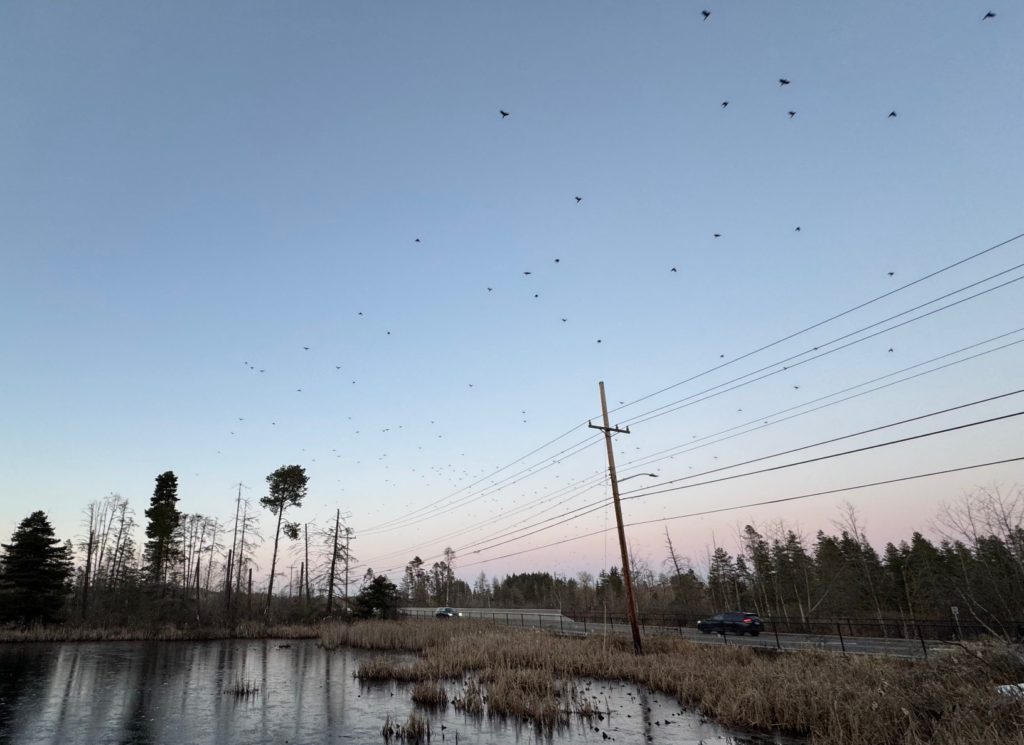
Every evening at sunset, American crows leave their daytime feeding grounds across the Seattle region — from neighborhoods in Seattle to suburbs like Everett — and make their way toward a central roosting site near the University of Washington Bothell campus. In peak years, 10,000 to 16,000 crows have been counted arriving at dusk.
Why do they do this?
The answer lies primarily in safety and social behavior. Crows are diurnal birds — active during the day but vulnerable at night. When thousands gather in a single roost, they benefit from safety in numbers. Predators like owls and raccoons are less likely to strike when confronted with a massive, alert flock. Shared roosts also help conserve warmth on cold nights and give the birds a chance to exchange information about food sources and local hazards.
How It All Began?
Bothell’s crow phenomenon seems to trace back to the restoration of the North Creek Wetlands on the UW Bothell/Cascadia College campus. During the late 1990s and early 2000s, this region was previously undeveloped land and was transformed into a wetland through the planting of willows, cottonwoods, and dense vegetation as part of a restoration initiative. Once the trees reached sufficient height by around 2009, crows discovered a perfect roost: dense cover for protection and a central location that minimized travel distance for birds across the region.
For many years, this nightly migration became a predictable ritual, drawing bird watchers, locals, and students who gathered to watch the sky darken as the crows arrived. Bothell even celebrated the birds with an annual “Crow Watch” event, complete with talks and viewing parties.
Changing Patterns and New Roosts
Recent observations suggest that the Bothell roost has changed in size and location. Some birds that once roosted at UW Bothell appear to be shifting toward nearby areas such as Redmond’s Willows Road wetlands, possibly due to habitat changes, construction, or natural roost dynamics.
Wonder if this impact on the Environment and Community?
The nightly crow congregation has had a mixed impact locally. On one hand, it’s a beloved natural spectacle — a reminder of the wild even in suburban landscapes. Bird enthusiasts delight in the aerial display, and many appreciate crows for their intelligence, social behaviors, and role in local ecosystems as scavengers and pest controllers.
On the other hand, such a large crow roost can be noisy and messy, with loud cawing and droppings in roost areas. Some residents have felt uneasy or annoyed, especially when large flocks gather close to homes or public spaces. But for many people, the nightly migration remains a unique connection to nature — a chance to witness wildlife in motion right outside urban life.
A Dusk Ritual Worth Watching
The next time you step outside at sunset and see a river of black wings drifting across the sky, remember: you’re witnessing a natural routine shaped by survival, community, and intelligence. And if you catch yourself smiling as they pass overhead — you’re not alone.
Reference:
https://www.uwb.edu/about/crows